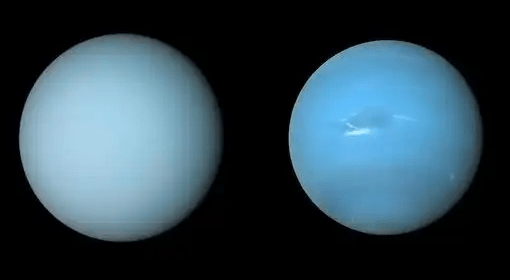
“Ice giants preserve pristine gaseous materials that record the evolutionary history of protostellar clouds and crucial information about planetary formation. These planets serve as vital subjects for studying the solar system’s origins and exoplanets,” Yang Mengfei, a senior scientist at the China Academy of Space Technology in Beijing and chief designer of the Chang’e 5 lunar mission, told China Daily in an exclusive interview. An ice giant is a colossal planet composed mainly of elements heavier than hydrogen and helium, including oxygen, nitrogen, carbon and sulphur. Two planets in the solar system, Uranus and Neptune, are categorized as ice giants. According to Yang, Uranus has the coldest atmospheric temperature in the solar system, with a minimum of about minus 224 C, and the most tilted rotation axis among all planets in the solar system. Meanwhile, Neptune, the farthest planet from the sun, has the strongest surface winds, reaching speeds of up to 2,100 kilometres per hour. Moreover, Triton, Neptune’s largest moon, is considered “the most likely extra-terrestrial body in the solar system to host microbial activity”, and may provide key clues to life’s origins.

 SANGHA KOMMUNE (SSR)