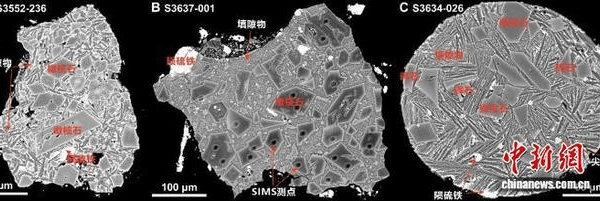
Fragments of impactor residues identified in the lunar soil of Chang'e-6 in this study. Photo courtesy of the scientific research team of the Guangzhou Institute of Geochemistry, Chinese Academy of Sciences

China: Scientists Discover Rare Meteorite Relics in Chang’e-6 Far-Side Lunar Samples! (21.10.2025)

Using advanced techniques to examine mineral composition and oxygen isotopes, the researchers scrutinized lunar soil and confirmed that the fragments came from CI-like chondrites — a type of meteorite rich in water and organic materials that typically originates in the outer Solar System.

The study implies that the Earth-Moon system may have experienced more collisions from carbonaceous chondrites than scientists had previously estimated.

This discovery not only indicates that material from the outer Solar System can migrate to the inner Solar System, but also has important implications for explaining the origin of water on the lunar surface, said Lin Mang, a researcher at GIG.
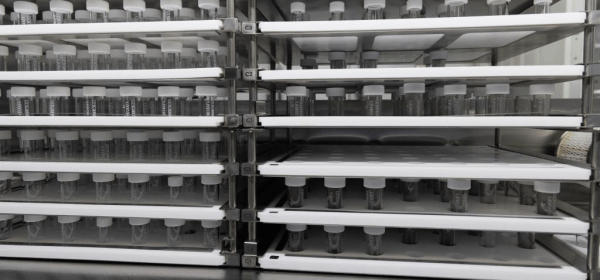
This photo shows lunar samples retrieved by the Chang'e-6 mission at the lunar sample laboratory in the National Astronomical Observatories of the Chinese Academy of Sciences (CAS) in Beijing, capital of China, Sept. 24, 2024. (Xinhua/Jin Liwang)

China: Research on Chang’e-6 [Dark-Side] Lunar Samples Underway! (11.10.2024)

A research paper published in September on the lunar samples brought back by the Chang’e-6 mission says that the Chang’e-6 samples exhibit “distinct characteristics” compared to previously obtained lunar samples.

The Chang’e-6 probe was launched from China on May 3, 2024. On June 25, its returner made a landing in north China, bringing back 1,935.3 grams of samples from the far side of the moon. (Xinhua/Jin Liwang)

Moon South Pole Samples!

China: Researchers Reveal Chang’e-6 Lunar Samples Composition! (18.9.2024)

The Chang’e-6 mission, however, marks the first time humanity has ever successfully collected samples from the Moon’s far side, returning 1,935.3 grams of precious material.

The landing site for this sampling mission was located in the South Pole-Aitken basin on the far side, specifically at the edge of the Apollo impact crater, an area where the lunar crust is extremely thin, potentially revealing primordial materials from the early impact basins. Particle analysis shows a bimodal distribution of grain sizes, indicating that the samples may have undergone mixing from different sources.

The study indicates that the Chang’e-6 samples contain not only basalt that records the history of volcanic activity on the Moon, but also non-basaltic materials from other regions.

The Moon is Red!

China: US Forgets Its Own “Anti-China” Bigotry During NASA “Moon Rock Begging” Outburst! (3.7.2024)

The Wolf Amendment, passed by the U.S. Congress in 2011, prohibits NASA-funded research in direct, bilateral cooperation with the Chinese government and China-affiliated organizations unless approved by the Federal Bureau of Investigation and Congress.  “China published the Announcement of Opportunities for the Chang’e-6 Mission, which was available to the entire world. We also welcome countries around the world to take part in the study of lunar samples,” she said.

China's Socialist Science Leads the World!

China Focus: Foreign Scientists Thank China for Sharing Lunar Exploration Opportunity! (3.6.2024)

The lander of the Chang’e-6 spacecraft also carried an instrument, called Negative Ions on the Lunar Surface (NILS), developed by the ESA/Sweden to the moon, which will be used to detect negative ions and study the interaction between plasma and the lunar surface.

Neil Melville-Kenney, NILS technical officer of the ESA, said the CNSA’s initiative to invite international partners to participate in the Chang’e-6 mission is very much appreciated by the international community.

“It’s a very impressive mission, a very ambitious mission. So we are very pleased to be a part of it. And the collaboration has gone very smoothly. Now we are waiting for the payload to be turned on so that we can get our first data,” he said.

“It’s very important to have international cooperation for space exploration. I think space exploration encourages us to consider our planet as one and our people as one. And it’s important that we work together as we start to explore the solar system more and more. Together we can achieve greater things,” he added.