Socialist China - Space Science!

China: Lunar Sample Reveals Far-Side Drier Than Near Side! (11.4.2025)

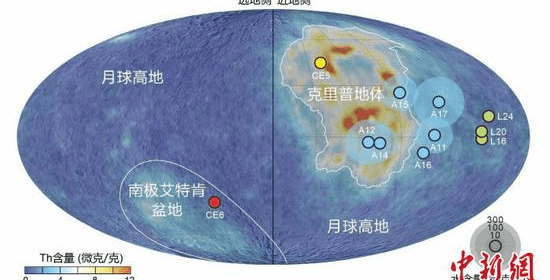
For nearly 20 years, there has been a debate over whether the water content in the Moon’s mantle, the middle layer between its surface and core, is abundant or scarce, while all published estimates were derived from near-side samples.

China’s Chang’e-6 lunar probe retrieved the first-ever lunar far-side samples from the Apollo crater within the South Pole–Aitken Basin, providing the first opportunity to determine the water content of the lunar mantle in this region.

The study revealed that a unique volcanic event dating back 2.8 billion years had not been observed in previous samples obtained from the near side.

Rock Samples Return!

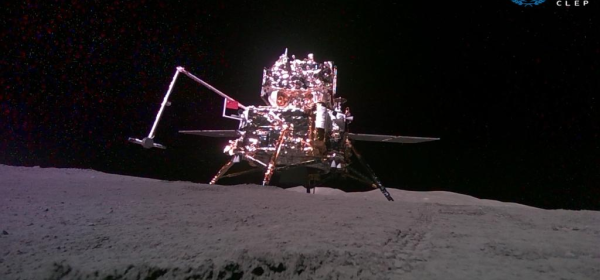
China: Chang’e-6 Lunar Module Safely Returns Dark-Side Rock Samples! (26.6.2024)

Lunar samples brought by the earlier Chang’e-5 mission have already drawn applications for access from international scholars, with the process well underway. The Chang’e-6 lunar probe carried four international payloads that were developed jointly by Chinese and foreign scientists. It is conceivable that the openness of Chinese lunar exploration activities will be mirrored in the study of Chang’e-6 lunar samples, said Yang.

The lunar scientific community and the entire humankind are anticipated to reap the rewards of collaborative efforts undertaken by international scientists from a wide range of geographical and disciplinary backgrounds, Yang added.

Zhang Kejian, head of the CNSA, said that exploring the vast universe is a common dream for all of humanity, and only open cooperation is the right path. China’s space endeavors will adhere to the principles of equality and mutual benefit, peaceful utilization, and inclusive development.

China's Socialist Technology Triumphs!

Socialist China: Humanity’s First Photographs of Moon’s Dark-Side! (4.6.2024)

Apollo 11, for instance, possessed a computer similar to that which operates most ordinary washing machines (the washing machine is believed to have positively altered human society to a far greater extent than the internet). The internet started as a US attempt to use telephone technology as a “spying” device in every room of the world. The idea was to develop a unifying computer technology which linked all telephones together so that they become, whether in use or not as an analogue communication device, a transmitter of all noise operating around or within the local vacinity (a function unknown to the owner) – broadcasting all this data to a Central Listening Headquarters in the US. A similar situation exists today – with all your emails, posts and other written sources of data uploaded onto the internet. All is observed, recorded and filed away by your National Governments – which report to the US.

Samples from Dark-Side Returns!

China: Spacecraft Returns with first Samples from Lunar Far-Side! (4.6.2024)

The control system of Chang’e-6 has also been enhanced to improve its autonomy, enabling it to complete lunar take-off and ascent with reduced reliance on the Queqiao-2 relay satellite and ground support, said Huang Hao, another space expert from the CASC.

The ascender is expected to carry out unmanned rendezvous and docking with the orbiter-returner combination in lunar orbit, and the samples will be transferred to the returner.

The orbiter-returner combination will orbit the moon, awaiting the optimal time to transfer back to Earth. When it approaches Earth, the returner carrying the lunar samples will re-enter the atmosphere, aiming for a touchdown at Siziwang Banner in north China’s Inner Mongolia Autonomous Region, the CNSA said.

New Moon Map!

China: World’s First High-Definition Lunar Geologic Atlas Published! (22.4.2024)

He mentioned that China’s upcoming Chang’e-6 mission is expected to collect samples in the Apollo Basin within the South Pole-Aitken Basin on the far side of the moon, which means materials ejected from ancient terrain may be collected in the process. “Our map can provide a macroscopic geologic background to improve the purpose and efficiency of the sample research,” Liu explained.

The compilation of this map was an immense task, which required the organization and cooperation of many well-informed researchers over many years to be able to achieve a consistent and complete result, commented Gregory Michael, a senior scientist from the Free University of Berlin in Germany.

“This map, in particular, is the first on a global scale to utilize all of the post-Apollo era data. It builds on the achievements of the international community over the last decades, as well as on China’s own highly successful Chang’e program. It will be a starting point for every new question of lunar geology, and become a primary resource for researchers studying lunar processes of all kinds,” Michael added.

China: Socialist Science to 3D Print Structures on Moon! (24.4.2023)

After Chang’e 6, the Chang’e 7 robotic probe will be sent to land on the moon’s South Pole to perform “high-precision investigations”, Wu said.

“The Chang’e 7 mission is meant to look for traces of water on the South Pole, investigate the environment and weather there, and survey the landform. The probe will carry a ‘flyby craft’ tasked with flying into pits on the lunar surface to look for ice,” the scientist said.

“Chang’e 7 will also be tasked with detecting the natural resources beneath the lunar South Pole’s surface. Mission planners are trying to assess if we can use the probe to dig into the surface and study underground structures and their composition,” he said.

In the long run, scientists will use components of the three upcoming missions — the orbiters, landers, rovers and sensors — to form the prototype of a robotic scientific outpost, which will act as a platform for international collaboration on lunar exploration, he added.