Museum Artefacts in St Albans!

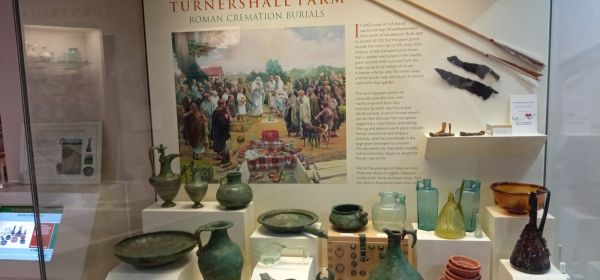
St Albans: Verulamium Museum! (29.5.2024)

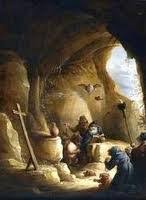
Of course, Roman rule was collapsing by the time (in the 4th century) that Christianity was becoming popular throughout the Roman Empire. Some wealthy Romans tolerated Christianity prior to this date (perhaps 3rd century) as being just one of many choices of belief from across their Empire – as the Roman Authorities were not yet exclusively “Christian”. This is why Celtic Christianity was probably from Egypt and premised upon the monasticism of the Desert Fathers – having little directly to do with Rome. The Catholic Church did not arrive as a State power in England until the Norman Conquest of 1066 (isolated Catholic Churches and monasteries had arrived in England prior to this date – but possessed no political influence or power with England’s Celtic Chiefs or Anglo-Saxon Kings). In just one-hundred years of its arrival in 1066 – this new and aggressive type of intolerant Christianity had wiped-out its Celtic cousin by the 12th century.
Long Live the 1381 Peasants' Revolt!

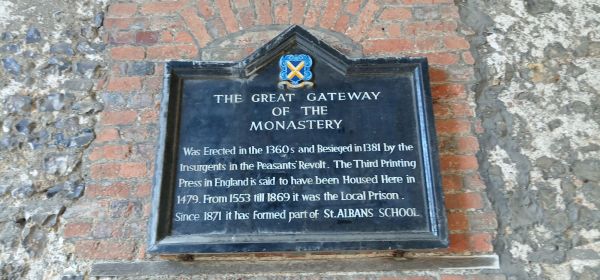
St Albans Abbey: Main-Gate! (28.5.2024)

During 1381 – England came within a hair’s breadth of becoming a People’s Republic! This great effort led by Wat Tyler was eventually defeated through the duplicity of the ruling classes – but its example echoes down through history! The beginnings of this gate stem from the 11th century and the consolidation of the Norman Conquest. This was when Roman Catholicism landed in England as part of the ruling government structure. Prior to this, Celtic Christianity (probably from Egypt) held sway in England, Wales, Scotland and Ireland. What Catholic presence there was prior to 1066 CE was piece-meal and generally lacked any real political power or influence. The differwence between these two forms of Christianity is that although both possessed a monastic tradition – the Celtic version saw the monastery (not the Church) as the centre of society. Furthermore, the Celtic version possessed a tolerant attitude toward non-Christian beliefs – a position rejected by the Catholic variant. With the coming of the politically empowered Catholic Church – Celtic Christianity was all but wiped-out by the 12th century.

The Ruins of Penhallam Manor – Northeast Cornwall – 30.7.15

Although only the foundations exist dating to 13th century renovations, (the home was eventually abandoned in the early 15th century), they reveal expert stone-masonry, architectural design, and building craftsmanship, as well as over-all expertise in positioning of the stricture and the good use of natural terrain, (the local river, for instance, was diverted to form the water in the encircling moat). The area of Penhallam was awarded to the de Cardinham family from France, and Penhallam Manor apparently served as one of their stately homes – such was the family’s importance in the new Norman social order in Britain. English Heritage maintain the site – which is free to enter for the general public. The ruins lie in a forest clearing that is about a 15 minute walk from the small car park (which is designed for 5 cars). It is a beautiful place to visit.