Tree of Enlightenment - Buddha Disappeared!

Perceptual Experiment: “Portrait of God” [Short Film]! (6.1.2024)

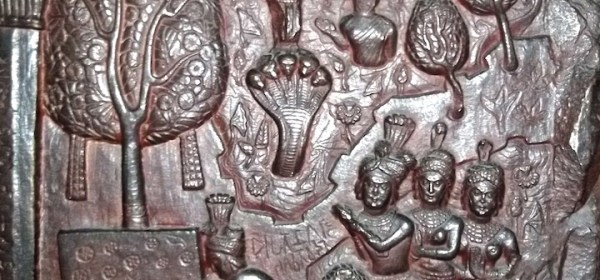
When the Buddha attained ‘Enlightenment’, the habitual karmic-power that continuously pulled together his physical and psychological existence fell away – leaving only the residual karmic-power of his present (final) bodily existence. Although the Buddha had broken the ridge-pole of continuous delusional habit – the physical body he occupied whilst attaining this position still had to be ‘lived through’ – until its biological functions naturally expired and its cohesive structure fell away. All of the material universe exists within empty space. Buddhist ‘Enlightenment’ seems to suggest a subjective appreciation of this external space and understands that all material expression exists within a continuous state of flux. As the Buddha broke-free of the human attachment to physical existence – his achievement was originally portrayed by his followers as ‘being not there’.
Dialectically Assessing Religious History! (16.7.2023)

An intuitive (collective) grasp does not constitute a material consensus. Of course, the work of Marx and that of the Bourgeois intellectuals featured above does intersect. Marx, however, must be ‘ignored’ because his method (if pursued to its logical conclusion) – not only exposes the inverted nature of religion – but also the inverted nature of the entirety of Bourgeois society (including those intellectuals who expose religion – but do not expose the predatory capitalism it creates and they rely on) because such an admittance would effectively end Bourgeois existence and see it subsumed within a Socialist Revolution!

Karma: Buddhist Action Defined.

‘The Buddha ascribes a special status to in the human realm (this realm is number 5 of the 31 – which occurs as a karmic stage within the broad category of ‘kama loka’, and is known as the ‘manussa loka’ – with ‘manussa’ meaning ‘human), and in so doing automatically elevates this karmic formation as being superior in potential to all other realms, or types of re-birth. It is true, of course, that as long as an ordinary human remains with a mind driven by craving (tanha), no progress can be made and the individual, as a collection of habitual tendencies will bob around on the karmic seas for innumerable ages, experiencing the painful fruits (vipaka) of karma. However, despite this immense image of futile suffering, the Buddha teaches that salvation is possible on the human plane through the understanding and practicing of the noble eightfold path – which is contained within the teachings of the four noble truths.’

1 2