Seizing power on August 23, 1975,

Laos Buddhist-Socialist Republic: Remembering “August 23rd” [1945] – and the Seizing of Power! (24.8.2025)

The day of seizing power on August 23, 1975 is of great significance to the entire Lao people, because such a victory is the fruit of the protracted Revolutionary struggle of the Lao people and the tribes under the leadership of the Lao People’s Revolutionary Party; It is the result of the ingenious courage of the use of the 3-step strategy to seize and hold power in the whole country without being overwhelmed, the victory of the correct Revolutionary line and the wise leadership of the Party, which knows how to creatively incorporate Marxism-Leninism into the actual behavior of the Revolution; It is the victory of the strength of unity, the unity of the whole nation, the unity of the army and the tribal people, the victory of the solidarity of the fighting alliance between the Lao people, the Vietnamese people and the Cambodian people who have stood shoulder to shoulder against the same enemy throughout the previous National Liberation Revolution, that is, in the mission of preserving and building the present nation.

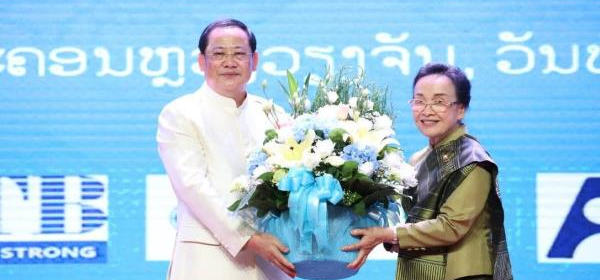
Ms. Naly Sisoulith praised the Lao Women’s Union for its active role in empowering women

Laos Buddhist-Socialist Republic – Leaders’ Spouses Celebrate 70th Anniversary of Lao Women’s Union! (19.7.2025)

In her remarks, Ms. Naly Sisoulith praised the Lao Women’s Union for its active role in empowering women, promoting gender equality, and supporting the Party and government’s socio-economic development efforts. 

She also paid tribute to past and present members of the LWU for their dedication to advancing the rights and well-being of women across the country.

Established in 1955, the Lao Women’s Union has grown into a vital mass organization with branches nationwide, playing a central role in mobilizing women to participate in political, economic, and cultural activities.

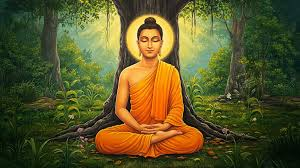
The Buddha's Enlightenment is Secular!

The Buddha & Secular Enlightenment! (3.7.2025)

If this was the case, why did the Buddha reject Brahmanism? Why did the Buddha bite the hand that fed him? Well, he practiced all the available meditative paths, mastered them all, and realised none of them expressed the ultimate truth. He carried-on training in meditation as the Upanishads advised – and saw through all the conditioning of his mind, body, and environment. He gave up caste privilege and all work for money. He knew that this would lead to starvation, homelessness, and nakedness. He resolved these issues by dressing himself in rags found in the charnel grounds (the clothing of dead who were to poor to be cremated), he acquired the skull-cap of a dead person and used it as a begging bowl as he walked from village to village quietly requesting waste-food on a daily basis, and he sat under the foot of a tree when he meditated. The Buddha left society and lived on the forested outskirts of Hindu society. Of course, the Buddha still physically lived in India, and interfaced with Hindu society, but he did this under a completely new contract of understanding.

Revolutionary Steering Committee - BMA (UK)

Directive Number 17 – The BMA (UK) Condemns the US-Israeli Military Aggression Against Iran! (22.6.2025)

Iran rejects various modes of cultural expression from manifesting in its society – in exactly the same manner as the West. However, Iran also pursues a left of centre political path which opposes blatant capitalism, and seeks to establish a society premised upon the most sublime teachings found within the Holy Qur’an. It is Iran’s anti-capitalist (and anti-Zionist) attitudes that causes the West to confront this regime – as a means to protect the fascist State of Israel. Just as long as Israeli apartheid, Israeli racism, Israeli fascism, Israeli imperialism and Israeli Zionism are allowed to exist unchallenged – then humanity will not be permitted to evolve to a higher-level of peaceful co-existence.

God and Jesus Do Not Exist!

The Objective Study of Religion Through Logic and Reason! (26.3.2025)

Needless to say, the learned Benedictine Brothers were not impressed with my missive – and certainly refused to print it in a Christian academic journal. One Brother took me to one side and explained that the Catholic concept of “Interfaith” was a misnomer – as its true purpose was to have the minds of Buddhists infiltrated by Catholic dogma – and for these Buddhists to “convert” to Christianity as a means to stop their heathen (non-White) souls descending into the fires of hell following their physical death. So far – so good. In military terms – this type of unscripted and quite often messy advance to gain intelligence about the enemy is termed “reconnaissance under fire”. The vehicle through which these Brothers delivered their condescending attitudes was one of racism and discrimination – disguised as religious piety (even those non-Whites who convert – are inferior to White Christians regardless of strength of belief). I was also informed that Asian Buddhists were invariably “Socialistic” – an ideology rejected by the Catholic Church.

Life of the Buddha!

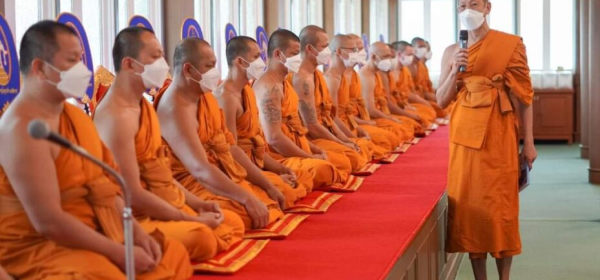
Laos: Buddhist Temple – “Golden Ground of Ram” [ວັດໃໝ່ ສຸວັນນະພູມາຣາມ – Wat Mai Suvanna Bhumi Ram]

Laos is a Socialist (Marxist-Leninist) State. Religious freedom is guaranteed as a private matter (through the separation of Temple and State) whilst Theravada Buddhism is the tradition religion of the people. Therefore, Laos may be considered a Buddhist-Socialist State – as the Buddhist Masters advocate Socialism and Dhamma in equal measure. In English, this old temple should be literally known as the “New Temple” – due to its relatively recent repair (just over 200-years) – by Royal Command. As to the Pali name – it translates as “Golden Ground of Ram” – “Ram” is an avatar of the Hindu god Vishnu. Throughout Southeast Asia and beyond, ancient Brahmanism spread far and wide from India – before the rise and spread of Buddhism. By the time Buddhism arrived in the region – Brahmanism was already in-place – with the Buddha being associated with Vishnu (even in modern India – many contemporary Hindus count the Buddha as an incarnation of Vishnu [Ram] sent to earth to encourage vegetarianism).

1 2 3 4 5 33