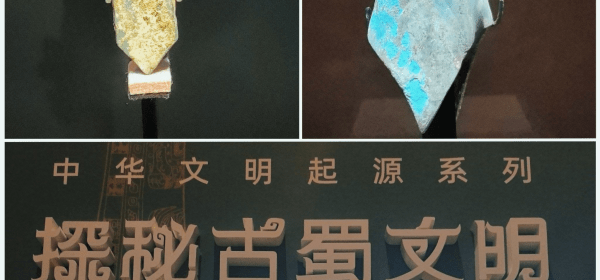
Ecns.cn 2025-09-28 (ECNS) — New archaeological findings at the Sanxingdui (Three Star Burial-Mound – or Three Star Tomb) Ruins in southwest China’s Sichuan Province have uncovered
Proletariat Blogging in the Heart of (UK) Predatory Capitalism! Exploring the Interface between Matter and Perception, Chinese Buddhism, Daoism, Hakka Ethnography, and All Aspects of Radical Politics, History, Psychology and Philosophy – 全世界无产者联合起来!
Ecns.cn 2025-09-28 (ECNS) — New archaeological findings at the Sanxingdui (Three Star Burial-Mound – or Three Star Tomb) Ruins in southwest China’s Sichuan Province have uncovered
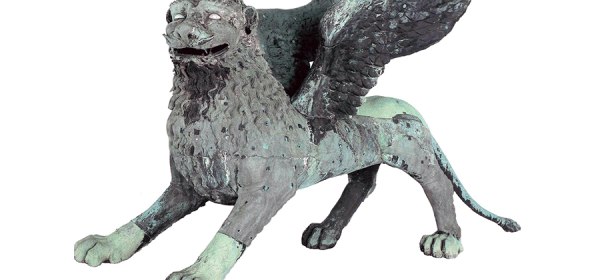
It would seem that between the Tang and (Islamic) Yuan Dynasties (around six-hundred years) this Lion sat dutifully outside a temple (or a tomb) – before being transported to the West and extensively “altered” to suit Western sensitivities – although it is highly likely that very few Europeans knew what an African (or “Indian”) lion actually looked like. Most Chinese lions I have seen are sat-down and I have never seen such an object stood-up on all fours. It would be interesting to see what the Lion in question looked like before the alterations. Finally, it is interesting that the British author (and former Submarine Commander in the Royal Navy) – Gavin Menzies (1937-2020) – wrote a book entitled “1434: The Year a Chinese Fleet Sailed to Italy and Ignited the Renaissance” (2008). He discusses the Chinese delegation that met with Pope Eugenius IV in Florence (1434) – and suggests that China had some type of diplomatic connection with the City States (which included Venice). Those who criticise Menzies’ work – are the same people who would never have allowed for idea that St Mark’s Lion could be of a “Chinese” origin. Given that this Lion arrived in Venice around 1264 – this Chinese Mission would have occurred only 166-years later.
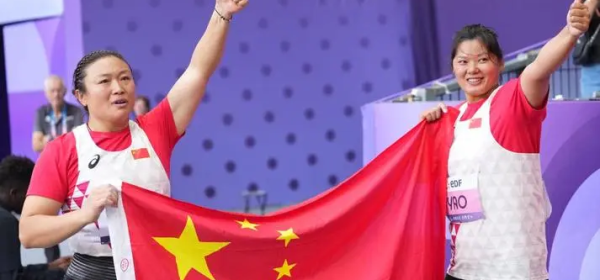
At the closing ceremony, swimmer Jiang Yuyan and track and field athlete Di Dongdong served as flag bearers for the Chinese delegation. The night before, at Paris La Defense Arena, 19-year-old Jiang shattered the world record in the women’s 100-meter backstroke S6 final with a time of 1:19.44, claiming her seventh gold medal at the Paris Paralympics.
“Standing on that podium, watching the flag rise and hearing the (national) anthem play because of my own hard work — it’s a feeling of pride and fulfillment that’s hard to describe,” Jiang said. “I often sing the anthem as loud as I can, I wonder if you can hear me.”
The Chinese delegation reaffirmed its dominance in swimming, athletics, table tennis, fencing and badminton, securing 22 gold medals in swimming and 21 in athletics.
Paralympic pool prodigy Guo Jincheng, who is easily recognizable with his shaved head and no swimming cap, competed in nine events, bringing home four gold and two silver medals.
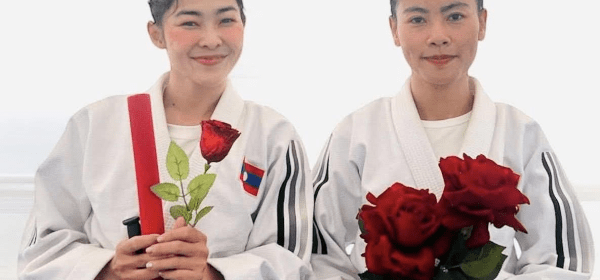
Of course, as an act of Solidarity with our brothers and sisters in Palestine, we posed for some of the photographs holding one of our Palestinian scaffs. The Israeli fascists have murdered over 20,009 Palestinian men, women and children and maimed over 70,000 in just four weeks using weaponry (much of it illegal) provided by the US and the UK. I wonder what the ancient ancestors of the UK would make of the fact that their descendents use the life they have given them to deprive others of just exactly that same thing! Perhaps they would drop to their knees in despair!
“If we can further testify ancient Pingyang existed through material proof, then the Chinese history of Yao and Shun would be changed from a legend to a real historical time,” archaeologist Xue Ruiming told the Global Times.
Xue added that the tomb ruins show the site’s “historical continuity.” He also said that ancient sites around Linfen are not only known to have “rich pottery relics,” but also hold great archaeological significance. The Taosi site is another site in the city that has more than 4,000 years of history.
Dating back 4,300 to 3,900 years ago, the Taosi site is a major archaeological spot that has been included in China’s national program dedicated to tracing the origin of Chinese civilization. Several notable relics, including a pottery plate decorated with dragon patterns was found at the site’s high-level tombs that once belong to local royalty.
A large rammed earth building wa
Copper ore leftovers, stove relics, and pottery were found in the northeast of the city. Archaeologists believed the venue had been used during the early to mid-Western Zhou Dynasty.
Dou Haifeng, vice dean of the School of Cultural Heritage at Northwest University, heading the excavation project, noted that the findings could provide valuable evidence for studies in the settlement layout, the composition of residents, and social change in the Shang and Zhou Dynasties. They are also significant for studying the origin and development of the Zhou civilization.