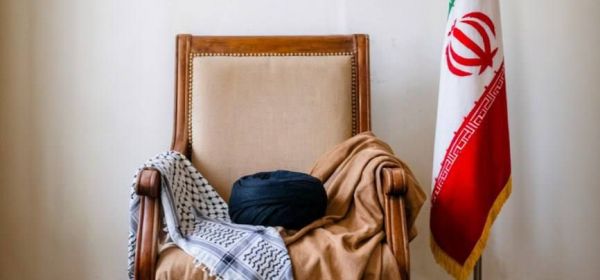
Out of respect, I am adding my contribution “below” the main story. It is interesting that within early Buddhist iconography – the Buddha (following his death) is never portrayed in his living form (that was a much later development) – but rather as some form of “empty space”. Indeed, for around 500-years following his Pari-Nirvana (Great Extinguishing) I believe it may have been a taboo to attempt to limit the Buddha to his (passing) physical manifestation (it seems that the Greek habit of making statues of their philosophers [in Gandhara-Afghanistan] that may have influenced the eventual development of Buddha-statues – either sitting [like the Jains] or standing [like Socrates]). One of the early depictions involve an “empty throne” (suggesting a king who has physically departed – but has left his authority in-place). Others involve two footprints, a flower, a tree, and a wheel, etc. The Buddha taught that although the material world “exists” – it is “empty” of any “permanent” or “lasting” entity – when viewed from the perspective of conscious awareness and a finite physical existence. Of course, Buddhism is not Islam – but I believe the Islamic Revolutionary State is hinting that the temporal authority Ayatollah Seyyed Ali Khamenei held due to his spiritual attainment – lives on in the face of the pure evil that Trump and Netanyahu both represent – even though his body has been destroyed by the agents of the devil.
 SANGHA KOMMUNE (SSR)