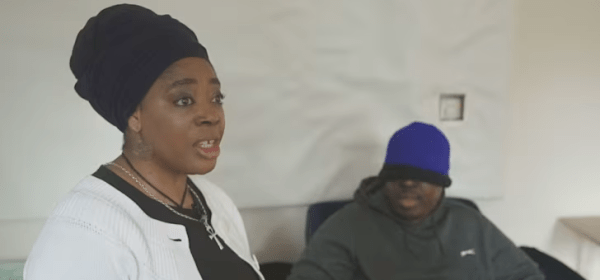
Sylvia Siddique told ITV News she worries about her son's future

UK: ‘It’s a Life-or-Death Situation’ – New Allegations of Disability Neglect at Lifeways Care Company! (9.4.2025)

“In August 2022, our then newly appointed CEO Andrea Kinkade launched a Transformation Plan. Backed up by over £10 million worth of investment, since then, the satisfaction of those we care for, and our staff, has improved.”Rebecca Bauers, Care Quality Commission Director for People with a Learning Disability and Autistic People, said: “The issues reported to ITV are clearly very distressing – no one should be put at risk due to poor care and where we need to, we will and have taken immediate action to protect people.

“We are monitoring Lifeways Community Care Limited closely, including carrying out inspections and are in regular contact with the Department for Health and Social Care regarding our findings.

“We are working hard to improve our regulatory oversight, including increasing the number of inspections we do to give the public confidence in quality of care.”
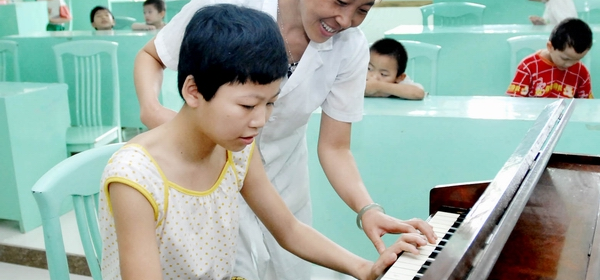

Disabled Children Treated with Compassion!

Across China: Rehabilitation Assistance Brightens Future of Disabled Children! (21.1.2024)

Many Chinese families have benefited from the National Assistance System for the Rehabilitation of Disabled Children since its establishment in 2018. In Gansu, designated Rehabilitation Institutions for Disabled Children have increased from 30 to 205 over the past years.

The Provincial Government also invests over 43 million Yuan annually to support the Rehabilitation Institutions, and that figure is expected to increase to 63 million Yuan in 2024. Some cities and counties further adopt diverse development models, including Public-Private Partnerships, to include more Disabled Children aged between 6 and 17 in the Rehabilitation Assistance System.

With the efforts of Hongmeng Disabled Persons’ Service Centre, over 20 children have returned to Primary School, more than 30 have integrated into regular schools, and over 10 gained employment in restaurants after turning 18.

Ruckersville [2009]: Chris Chan Is Working On It! (4.9.2023)

Interestingly, Robert Chandler (a US Army Veteran who fought in Korea) – was a very successful engineer in his civilian life – whose many different patents also contributed to the development of the 3-D Printer! Apparently, the family made a comfortable living from these patents whilst Robert was alive and it is something of a mystery as to ‘why’ this income never continued to help Chris and Barbara after his death in 2011. Furthermore, although Chris suffers from Autism – he made an attempt to keep his bedroom relatively free of the clutter that dominated the rest of the living space. Robert Chandler is well aware of the reality (and ‘danger’) of ‘hoarding’ – and explains this to Chris whilst not realising the camera is still running and whilst assuming that the internet is situated in a specific location somewhere in the outer world! He is referred to as the ‘Lumberjack’ – as he once implied he could ‘cut-down’ the internet!

Chris Chan [☨陳]* – Following the Light of the Candle! (3.9.2023)

A few years ago – I was contacted by a friend in China who asked me who this Western person was who has a Chinese surname (‘陳’ or ‘Chan’ the same name as that used in my family). I was intrigued, as the person in question seemingly pronounced the Chinese language ideogram ‘陳’ in exactly the same way as the Chinese branch of my family does, denoting a Hong Kong, New Territories or Guangdong (Cantonese) origination. Indeed, within North China – the ideogram ‘陳’ is usually referred to as ‘Chen’ (particularly in the Putonghua ‘Official’ language usage) – although in the Hokkien dialect of Southern Chinese Fujian province it becomes ‘Tan’ (in Vietnam it is ‘Van’), etc. Historically, and in one way or another we are all related – although the Sai Kung (New Territories) ‘Chan’ people are of ‘Hakka’ – or of Middle to North China origination! Although the Hakka people are part of the Han majority that comprise the Chinese people – there are persistent rumours that in the distant past some DNA influences within the Hakka genetic identity originate outside of North China and could well have involved typically non-Chinese traits (such as those found in Europe and Africa, etc).

China: New Law Assists Visually Impaired Citizens! (2.9.2023)

In Beijing, Liao Juan, an associate professor at Capital Normal University’s School of Management, said the law closely addresses the demands and expectations of the elderly and the disabled in terms of system design, establishing standards, and construction requirements.

She said the process of formulating the law is the best example of how the nation’s top legislature responds to public needs.

To implement the law and make it work effectively, the Ministry of Industry and Information Technology said it will give stronger support to technological innovation in constructing accessible services.

The use of new technologies to guide the blind, along with voice control and speech recognition, will be encouraged, the ministry said, adding that it will also require enterprises to “bridge the digital gap” to ensure the elderly and disabled enjoy technological convenience.

The China Disabled Persons’ Federation has promised to organize visits to accessible facilities and provide feedback to relevant departments.

The federation also said it will compile and publish more books in Braille and provide versions for those with poor vision.

Grunya Sukhareva (Груня Сухарева) [1891-1981] – Forgotten Soviet Pioneer of ‘Autism’ Research (1925) 

During her lifetime, Sukhareva opened such schools all over the country. However, its influence and authority did not go beyond Soviet borders, which was the result of political and language barriers. Only a small part of the Soviet research of that time was translated into other languages, very often it was German rather than English. Although her work of 1925 was translated into German the following year, the translation was unsuccessful, even the name of the author of the work was distorted as “Ssuchareva”. The work was translated into English only in 1996, 15 years after Sukhareva’s death, when Sula Wolff, a British psychiatrist, stumbled upon it. 

1 2 3