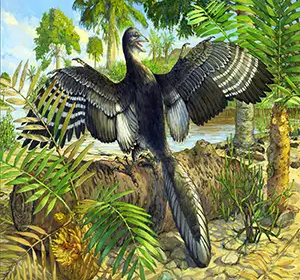
Illustration showing Archaeopteryx in life, including its tertial feathers that would have helped it fly. Credit: Michael Rothman. Click image to enlarge.

US: Ongoing Analysis of – Archaeopteryx Fossil – Continues to Proves Darwin Right! (21.3.2026)

Differences in modern birds

Modern birds evolved shorter upper arm bones and specialized tertial feathers to close this gap.

Remarkably, the Chicago specimen of Archaeopteryx shows it had long tertial feathers too – something unseen in its flightless dinosaur relatives.

“Our specimen is the first Archaeopteryx that was preserved and prepared in such a way that we can see its long tertial feathers,” she noted.

These feathers, absent in closely related non-avian dinosaurs, suggest those creatures couldn’t fly.

“That tells us… Archaeopteryx could,” O’Connor added. “This also adds to evidence that suggests dinosaurs evolved flight more than once – which I think is super exciting.”

Fujian Scientists Make Evolutionary Discovery!

China: Jurassic Fossil Discovery Sheds New light on Origin of Birds! (13.2.2025)

While it is well established that birds evolved from dinosaurs, the timing of this transition has long been debated. Some studies suggest that birds’ earliest diversification occurred during the Jurassic Period, though the fossil record has been sparse and fragmentary. Archaeopteryx, often considered the earliest known and arguably the only Jurassic bird, has long been the focus of this debate.

Although Archaeopteryx possessed feathered wings, it closely resembled non-avian dinosaurs, particularly due to its long, reptilian tail, which is in stark contrast to the short tails seen in modern birds. Recent research has even questioned whether Archaeopteryx should be classified as a bird, suggesting instead that it may be more closely related to the deinonychosaurs, a group of theropod dinosaurs.