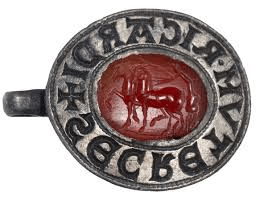
The finely-carved Roman gemstone shows a charioteer standing on a racing chariot, with whip in hand, urging on two high-stepping horses

England: Latin Medieval Seal – Reading “+SECRETVM . RICARDI” [with Roman Gem-Stone] Unearthed! (2.2.2026)

The inscription – which reads +SECRETVM . RICARDI – shows the seal was created specifically for a man called Richard.

He would have used it to make a mark in hot wax to seal his letters and documents.

Richard appears to have specifically chosen the carved gemstone, known as an intaglio – possibly as a way of showing he had an understanding of the Classical world, according to Miss Rogerson.

She said: “It definitely would have been an indicator of the owner’s social status as a way of saying, ‘I have the means of obtaining something from a far gone time and place’ and indicated they were quite important – or saw themselves as quite important.”
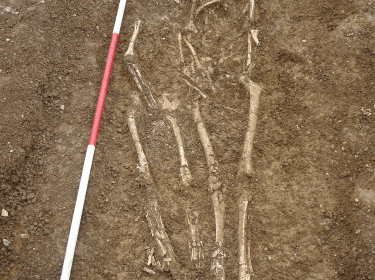
Human skeletal remains in a double burial at the Worth Matravers cemetery.

UK: Ancient DNA Reveals West African Ancestry in Early Medieval England! (4.1.2026)

Archaeologists have analysed the DNA of two unrelated individuals buried in seventh-century-AD cemeteries on the south coast of England, revealing that they both had recent ancestors, likely grandparents, from West Africa.

During the Early Middle Ages, England saw significant migration from continental northern Europe. Historical accounts describe the settlement of Angles, Saxons, and Jutes, who gave their names to the Anglo-Saxon period and perhaps the country itself. However, the extent of movement from further afield was less clear.

“Migration and its direction, scale and impact have been much debated in European archaeology,” state the authors. “Archaeogenetic research can now provide new insight, even identifying individual migrants”.