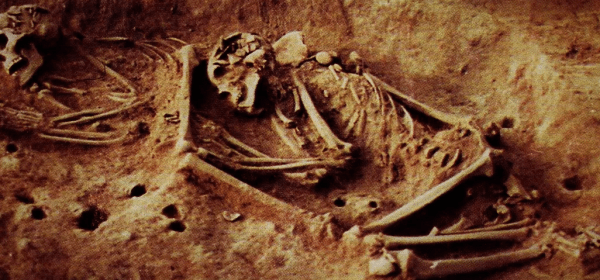
These skeletons of two hunter-gatherer individuals excavated at the Checua archaeological site north of Bogotá, Colombia, helped uncover the genetic details of a mysterious population. Ana María Groot / Universidad Nacional de Colombia

Colombia: Ancient Checua DNA Reveals “New Group of Humans” With No Genetic Ties to People Today! (4.1.2026)

Scientists have found genetic evidence of an ancient group of people in Colombia with no modern-day descendants. It’s as if they simply vanished from the face of the Earth. What’s more, they’re also not closely related to the ancient Native American populations that scientists had thought would be their ancestors.

“This is unexpected,” Andre Luiz Campelo dos Santos, an archaeologist from Florida Atlantic University who did not participate in the research, tells Adithi Ramakrishnan at the Associated Press. “Up to this point, we didn’t believe there was any other lineage that would appear in South America.”

An international team of researchers described the discovery in a study published in late May in the journal Science Advances. They analyzed DNA from the bones and teeth of 21 individuals found at five archaeological sites in the Altiplano—the high plains around Bogotá—dating to between 500 and 6,000 years ago. The analyses represent Colombia’s first ancient human genomes ever to be published.
China: 6,000-Year-Old “Male” DNA Found in Matriarchal Society! (24.9.2023)

According to experts, by comprehensively analyzing and comparing the environmental differences, living and production levels, artistic and aesthetic inheritance and human physical changes between then and now, the excavation has revealed that the human history of Wuxi dates back to at least 6,000 years ago. 

The relics and artifacts unearthed from the site have become “living fossils” of the matriarchal society in the area.

The Majiabang Culture was named after Majiabang village in Nanhu, East China’s Zhejiang Province, where it was first discovered in 1959. 

Archaeological surveys over the years have shown that the Majiabang Culture, a matriarchal society, was bridged by the Songze Culture before this area completely developed into a patrilineal society. After that it reached the threshold of state civilization after it combined with the Liangzhu Culture, a highly developed ancient culture in the late Neolithic Age in the Yangtze River Delta.