Abbot's Kitched - Glastonbury - 2024

Glastonbury Abbey: Abbot’s Kitchen – St Joseph’s Well! (30.7.2024)

Today, an ad hoc “Wishing Well” has developed in one of the corners of the room. This was probably a drain or perhaps some type of cooker – but in modern times visitors have taken to dropping coins down through the covering grill – and making heartfelt requests in the form of prayers and good wishes. Our daughters asked for good health to be bestowed upon Nana (Diane Wyles), Granddad (Peter Wyles) and Charlotte (my younger sister)! The currency observed spans the globe – which demonstrates the universal appeal that Glastonbury holds. This is not necessarily “religious” (although religion is important for many) – but rathe “spiritual” in nature – the latter category being far more inclusive and all-embracing!

King Arthur May Well Have Been a Historical Personage!

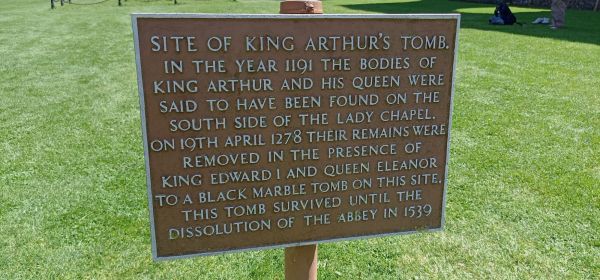
Glastonbury Abbey – King Arthur’s Grave! (29.7.2024)

The Celtic Church (from Egypt) was probably in Britain from the 2nd century CE onwards – with it being destroyed by the incoming Roman Catholic Church by the 11th century CE. Its monastic nature encouraged not only cloistered monks who lived in draughty stone cells – but also Hermits who lived in natural caves or various other meditation cells. Celtic Christianity did not persecute – but encouraged and accommodated the Pagan beliefs of indigenous people. There was a mutual respect between both groups of believers and this explains why leaders like King Arthur would strive to protect the Church – and the Church to honour him in death. This type of Asiatic respect does not require a slavish attachment to belief to be functional. Freedom of belief equates to respect for difference. There are many theories dating King Arthur from the 6th, 7th and 8th centuries, etc, which include many geographical areas associated with his life and death. We favour Tintagel in Cornwall – a place we have visited many times. King Arthur was a wise man, a compassionate man, and a great warrior!

Gee & Me - St Albans Abbey - 2024

St Albans Abbey: Interior & Enclosures! (29.5.2024)

Abbot, Abbesses and other Head Monastics were offered a life-long pension from the Crown amounting to 1% of the annual income of the monastery being dissolved. As St Albans made around £1000 per year – the Abbot received a guaranteed £10 per year – a very substantial amount for the time. The idea was to purchase their compliance. Those who resisted were tried for Treason and publicly executed. Henry gave away monastic property to his favourites – or sold it at a cut-price to other interested parties. All the accumulated gold, silver, copper, led and bronze, as well as gemstones – were sold into the public domain and effectively laid the foundation for a modern capitalist economy. This freeing of monastic treasure into the public domain represented a massive injection of wealth into the English economy – stimulating buying, selling and market speculation. When the movable wealth ran-out – the brick-work and foundations of many monasteries were dismantled and used to reinforce Henry’s castles along the coast – or in the case of Merton Abbey – to build Nonsuch Palace in Surrey! Whereas the monks were opposed to greed and grasping – a new secular society emphasised the exact opposite to get on. Now, greed, lying and cheating guaranteed the personal accumulation of wealth that could purchase a place to live, schooling, food, travel and leisure, etc. Of course, supporting Henry often guaranteed social climbing. Modern capitalism was invented in England by Henry VIII.

St Albans Abeey - Grounds

St Albans Abbey: Clock-Tower & Exterior Structure! (29.5.2024)

Ordinary peasants and aristocracy would get out of bed in the morning, work, eat, rest and go to bed at night according to the dictates of the Roman Catholic Church – the monasteries of which usually followed the Rule of St Benedict – or some similar Rule. Ordinary people did not have to learn how to tell the time – as the monastic orders told them what to do and when to d it. Following the “Dissolution” – secular society had to build their own clocks and learn to tell the time for themselves. This is how the measuring of “time” was rescued from the control of the Church. After 1539 – time no longer served God – but rather the lay-society that paid for and possessed the technical skills to construct the clocks! The policies of King Henry VIII – as mad as he may or may not have been (he had around 70,000 men and women hanged during his reign) – ushered the “modern” Britain that we now live within. I doubt, however, that Henry would have envisioned the end of absolute monarchy or the trivialising of the Church!

St Albans Abbey was Once the Greatest in the UK!

St Albans Cathedral: WWI – The Verdun Tree! (27.5.2024)

Not mentioned in this bourgeois memorial is the fact that widespread “Socialist” uprisings spread throughout the French Army due to the callous attitudes of the French Generals. Research shows that around 7000 Frenchmen were arrested and Courts Marshalled – with 629 being sentenced to death by firing-squad (49 of these executions were eventually carried-out). Many Frenchmen were acting in sympathy with their Russian Allies – the soldiers of whom were participating in the 1917 Socialist Revolution! This is a clear example of the bourgeois censorship of history which only partly informs the masses about the reality of their own history! The British mass murder of the Battle of the Somme soon followed Verdun – where the bourgeoisie demonstrated to the working-class that the middle-class still controlled society – which led to 60,000 British casualties in the first 20-minutes!

Sutton: St Nicholas Church – Interior and History! (10.9.2023)

Since around 1539 CE (and Henry VIII’s Dissolution of the Monasteries) this Church has been ‘Protestant’. This is a large Church built for a substantial Township and can probably hold at least 100 worshippers at any one time. Bear in mind that there used to be a greater number of Churches in the UK per small area than there are today – and that populations used to be far smaller despite virtually everyone professing a faith. Perhaps the ample and impressive size of the Church is linked to it serving a local population with a higher social status and wealth – requiring certain standards as being seen to be kept! As far as we are concerned, archaeological structures retain the data of the past, and by studying these structures we are able to glimpse into that past!