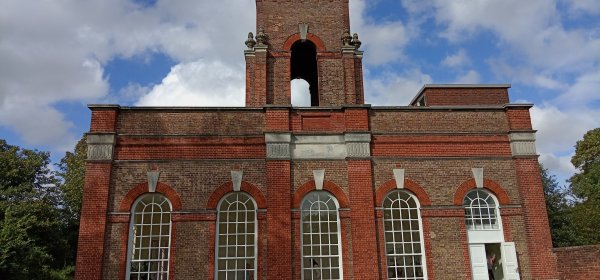
Sutton: Visiting the Carshalton Water Tower! (24.9.2023)

As immense wealth was generated through the labour of the exploited masses (which involved the development of the Trans-Atlantic Slave Trade) a privileged middle-class developed – particularly after the English Civil Wars of the 1640s. This development saw the successful transference of the control of the ‘means of production’ (and political power) from the Aristocracy (the upper-class) to the Bourgeoisie (the middle-class) and with it the unleashing of tremendous creative force (a process magnified enormously by the ‘discovery’ of the Americas and the effective stealing of immense tracts of ‘free’ land and other resources)! Of course, the spread of British power and influence throughout other countries of the world – including Africa and Asia – opened all kinds of diverse markets which spread commodities to the four corners of the earth!
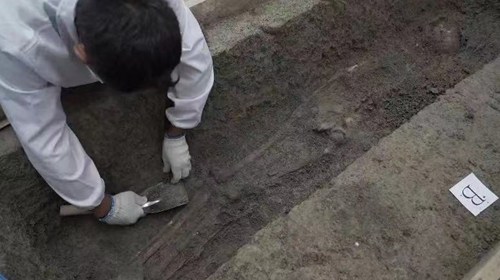
China: Modern Archaeology Proves Historicity of Emperors Yao & Shun! (24.9.2023)

“If we can further testify ancient Pingyang existed through material proof, then the Chinese history of Yao and Shun would be changed from a legend to a real historical time,” archaeologist Xue Ruiming told the Global Times. 

Xue added that the tomb ruins show the site’s “historical continuity.” He also said that ancient sites around Linfen are not only known to have “rich pottery relics,” but also hold great archaeological significance. The Taosi site is another site in the city that has more than 4,000 years of history. 

Dating back 4,300 to 3,900 years ago, the Taosi site is a major archaeological spot that has been included in China’s national program dedicated to tracing the origin of Chinese civilization. Several notable relics, including a pottery plate decorated with dragon patterns was found at the site’s high-level tombs that once belong to local royalty. 

A large rammed earth building wa

China: 6,000-Year-Old “Male” DNA Found in Matriarchal Society! (24.9.2023)

According to experts, by comprehensively analyzing and comparing the environmental differences, living and production levels, artistic and aesthetic inheritance and human physical changes between then and now, the excavation has revealed that the human history of Wuxi dates back to at least 6,000 years ago. 

The relics and artifacts unearthed from the site have become “living fossils” of the matriarchal society in the area.

The Majiabang Culture was named after Majiabang village in Nanhu, East China’s Zhejiang Province, where it was first discovered in 1959. 

Archaeological surveys over the years have shown that the Majiabang Culture, a matriarchal society, was bridged by the Songze Culture before this area completely developed into a patrilineal society. After that it reached the threshold of state civilization after it combined with the Liangzhu Culture, a highly developed ancient culture in the late Neolithic Age in the Yangtze River Delta.

China: Body of Korean War Veteran – Li Zhonghua (李中华) – [Missing Since 1958] Found in 2016! (24.9.2023)

The Police deduce that Li Zhonghua (and his fellow soldiers) set-off from Luoyang – with Li Zhonghua struggling to keep-up due to the after-effects of his leg wound (which slowed him down). As the country was in need, however, Li Zhonghua ‘Volunteered’ yet again and was given ‘Special Tasks’. Before setting-off from Luoyang that day – Li Zhonghua bought a copy of a local Newspaper – a datable object found on his body in 2016. Due to the harsh environment (and Li Zhonghua’s injured leg) – he soon fall behind as the troops advanced. In such an environment, a person alone, without food, clothing and water would not be able to retrace their steps or go onwards with any certainty. Li Zhonghua marched on until his strength gave-out – and a grateful country rediscovered his remains!